Experimenting with digital technologies and their relationship to storytelling, discourse and authorship
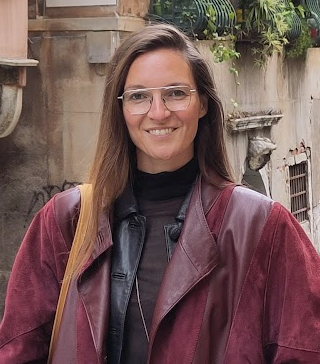
Kate is a documentary filmmaker, researcher and educator. Her work advances a practice-based methodology for documentary engagement with systems of power – surveillance regimes, corporate practices, institutional opacity – that resist conventional documentation. As well as engaging critically with the social and political impacts of new technologies, she is invested in using technology to adopt innovative visual approaches to documentary storytelling, experimenting with software and digital tools in nonfiction contexts.
Kate’s recent short film, Thank You For Allowing Me To Speak With You Today, utilises deepfake technology to generate realistic, fake footage of Elon Musk performing a speech using censored words. The film is currently touring as an installation at festivals and conferences including Mozilla Festival (Barcelona), Archive and Resist Conclave (Dhaka), and re:publica (Berlin).
Her other works as Director include the BFI-backed feature documentary Phantom Parrot, which explores civil liberties and digital surveillance through the lens of a human rights activist prosecuted for his refusal to hand over his password. Phantom Parrot premiered at CPH:DOX and Sheffield Doc/Fest, screened theatrically across the U.K. and in the Houses of Parliament, and was acquired and distributed by Tribeca Films in North America.
Kate’s work has won a Grierson and an RTS Award (Fake News Fairytale, 2018), and screened at festivals and galleries worldwide (BALTIC Centre for Contemporary Art, BFI London Film Festival, DOC NYC). She has lectured at the Royal Academy of Art in the Hague, UCL, and the National Film & Television School, where she completed her M.A. in Directing Documentary.
The Host and Project
For my StoryArcs Fellowship, I am based at the Sonic Screen Lab, a research hub at the University of the Arts London that interrogates and experiments in moving image and sound-based practices and their relationship with culture, environment and social change. During my time at Sonic Screen Lab, I am working on a research project investigating the use of creatives’ work as training data for image-based generative AI tools.
My project involves facilitating a dialogue between artists and generative AI systems, using a massive dataset called LAION-5B to explore how artists’ work has been used to train Vision Language Models. I am working with the arts practitioners and scholars at the Sonic Screen Lab whose’ work exists within this dataset.
Alongside my research, I am developing strategies to support discourse and dialogues originating from the Sonic Screen Lab, within and beyond the university. This has taken the form of collaborating on Sonic Screen Lab projects such as an event series focused on members’ creative research; a digital presence for the hub; and a podcast dissecting the creative process.
The Journey So Far
I joined the Sonic Screen Lab in May 2025. I was drawn to the placement as an opportunity to explore the potential of an academic research hub to foster a robust creative community at a time when the creative industries are under mounting political, commercial and institutional pressure.
I began by embarking on a series of open-ended interviews with the core members, using these insights to feed into strategic discussions about the role of the Lab within the university and beyond, as well as the creative direction of the Lab’s new website, and ongoing digital presence. My work has evolved along intertwined strands.
The first strand has been community-facing: supporting Sonic Screen Lab in building out an event series focused on its creative research, including with an event – ‘Synthetic Media, Satire and Subversion’ – in which I discussed the challenges and opportunities of working with generative AI in creative practice, using my latest short film as a case study. The second has been my own research into the use of creatives’ work as training data for generative AI systems, for which I have been recording interviews with artists affiliated with the Lab about their relationship to AI, both through their creative practice and as educators in higher education.
The most significant shift over time has been in how I think about the form of research itself. When I began my Fellowship, I assumed that a linear film would be the natural output – an assumption rooted in my documentary practice. However, as the interviews and discussions have unfolded, I have begun to question whether a single authored narrative can hold the plurality of voices, positions and perspectives, instead moving towards a form that is representative of artists in dialogue with opaque, non-linear systems.
As I near the end of my Fellowship, I am synthesising the interviews and visual material into a series of interconnected outputs: a custom-built chatbot enabling artists to converse with a persona representing the LAION-5B dataset; a short film introducing the project; and a reflective piece of writing. I am also collaborating on a new Sonic Screen Lab endeavour – a series of podcasts about the creative process – which I see as relevant to my research about AI and creativity.
Hopes and Plans for the Future
My project will result in various outputs across digital platforms, documenting the ongoing research and creative practice of the Sonic Screen Lab’s core members. In addition, my project will lead to an interactive website, bringing to life the process of investigating the digital footprints of different creatives as training data for Vision Language Models.
In the future, I plan to build on my existing work engaging critically with the social and political impacts of new technologies, using my position as a documentary practitioner to experiment with innovative aesthetic approaches to storytelling. I have found my placement at the Sonic Screen Lab and University of the Arts London more broadly to be a generative environment for exploring new ideas, questions and concepts. Moving forward, I hope to continue an affiliation with an academic institution in order to root my creative practice in the kind of reflexive, critically-engaged community that I have found valuable during my fellowship.
Story Skills In Action
In my role as a storyteller within the Sonic Screen Lab, I am utilising technology to facilitate dialogues within the Sonic Screen Lab and beyond. Inviting the artists associated with the Lab to collaborate on an investigation into their relationship to generative AI tools, my work seeks to build literacy and nuance into critical conversations about technology and creativity. As my project has developed, I have sought to use technology to enable artists to speak back to opaque technological systems that are designed to erase provenance. In this endeavour, I am centring the voices of the creatives who are profoundly affected by generative AI but who have often found their perspectives marginalized in the development of these tools.
During my year at Sonic Screen Lab, I have also been a regular exhibitor and speaker on the topic of technology and storytelling at conferences and events including:
- Fog of Falsehood: Disinformation, AI and the Battle Over Reality (Double Exposure Investigative Film Festival & Symposium, Washington, D.C.)
- Mozilla Festival (exhibition of AI-generated short film – Thank You For Allowing Me To Speak With You Today)
- Fall of Freedom (virtual screening of Thank You For Allowing Me To Speak With You Today, as part of a U.S.-wide call for artists responses to authoritarian forces and censorship).
- re:publica (forthcoming exhibition of AI-generated short film – Thank You For Allowing Me To Speak With You Today)
What Does StoryArcs Mean To Me?
StoryArcs, to me, is an opportunity to understand, articulate and demonstrate how vital storytelling is for our communities and for society at large.
Meet more Story Fellows:
- Interested in documentary and filmmaking? See how Story Fellow Panya Banjoko is using these skills in her project with Nottingham City of Literature.
- Read about Story Fellow Marusa Levstek’s London based project with AKO Storytelling Institute.